 Enterprise Alignment
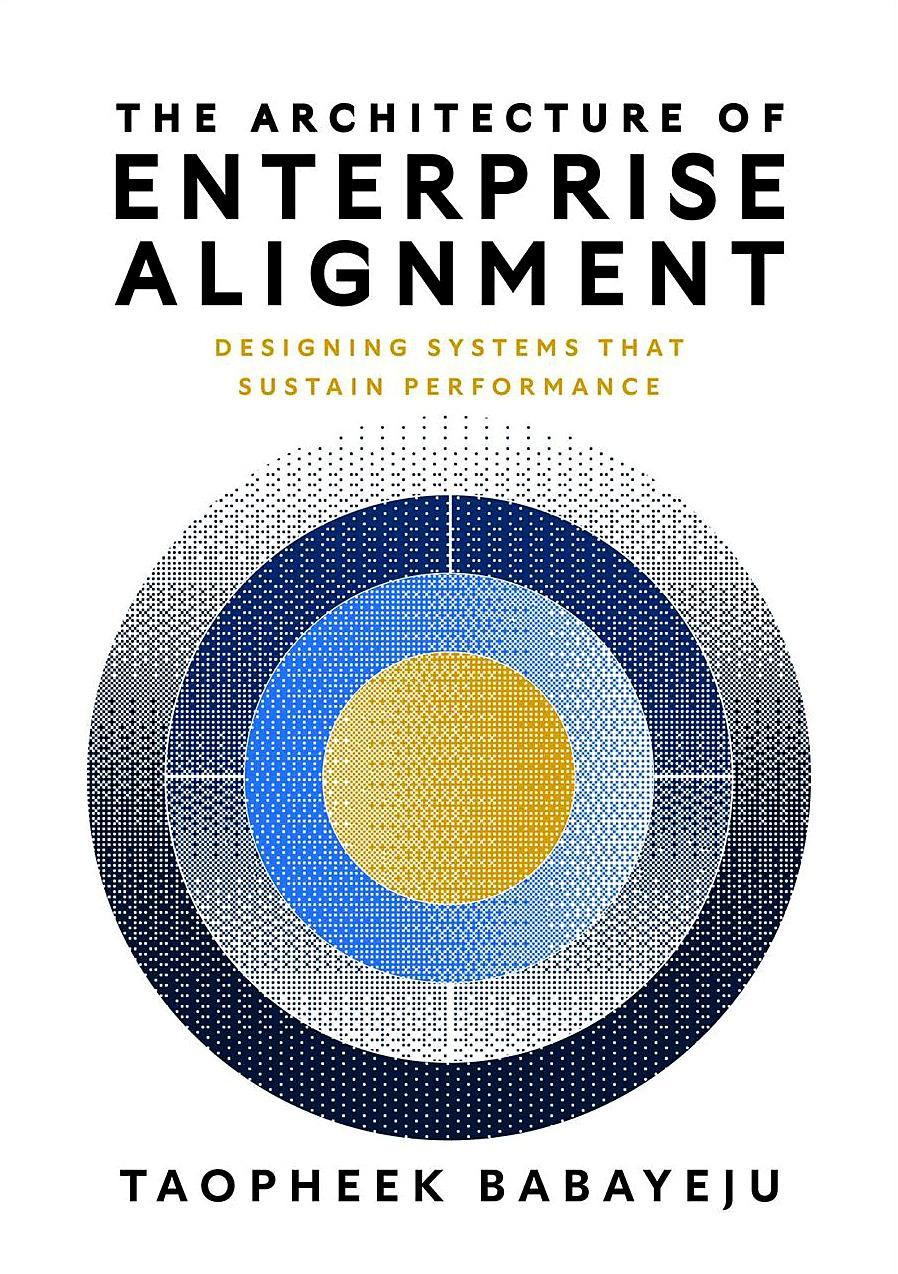
The Architecture of Enterprise Alignment
Designing Systems That Sustain Performance
In The Architecture of Enterprise Alignment, Taopheek Babayeju introduces Enterprise Alignment and the 4P Alignment Architecture™, a systems-based approach to connecting Portfolio, Project, People and Product so that strategic direction, execution, capability and value creation reinforce one another.
Launching November 2026. Retail links, formats and ISBN to be added at publication.
- Structure
- 3 parts · 17 chapters
- Includes
- 25-item self-assessment
- Cases
- Africa, Asia, Europe, North America
Organizations do not fail for lack of ambition. They fail when the systems required to deliver that ambition are misaligned.
Most organizations that struggle to sustain performance do not have a strategy problem, a talent problem or an effort problem. They have an architecture problem. Their Portfolio, Project, People and Product systems each pull in slightly different directions, and the friction builds quietly until it can no longer be ignored.
The book gives leaders a structural language for seeing that problem and a framework for designing it out. Its argument is that alignment is a property of design, not intent, and that the work of maintaining it is the permanent work of leadership in complex institutions.
It names a problem leaders feel but rarely diagnose.
When performance falls short, the default diagnosis is execution failure. The book argues that this is usually a misdiagnosis, and that strengthening execution inside a misaligned system produces a heavier organization, not a stronger one. It is written from twenty-five years of institutional practice and tested against named, verifiable cases.
Who should read it
From diagnosis to design.
Praise for the book
“We need to reframe enterprise alignment as a system-level capability rather than just episodic coordination. The book’s concepts offer a timely perspective for senior leaders shaping the future of value delivery and the evolution of our profession.”
“Taopheek Babayeju gives leaders a compelling language for diagnosing what is often described as ‘execution failure’ but is frequently an architectural failure.”
“A valuable book for policymakers, executives, transformation leaders, and others interested in building institutions that do not merely perform but are architected to sustain performance.”
“He challenges leaders to look beyond individual projects and consider whether the enterprise itself is aligned to consistently translate strategic intent into measurable value.”
“Beyond diagnosing the problem, Taopheek defines the solution: the 4P Alignment Architecture™, a framework for enabling organizations to move from Strategic Intent to Value Realization.”
“The concept offers a clear, practical way to connect portfolios, projects, people, and products into a coherent system, shifting organizations from managing initiatives to consistently advancing strategic vision.”
“It reframes performance challenges through a systems lens rather than a simplistic execution lens. Too often, leaders assume strategy or discipline is the issue when the true barrier is structural misalignment.”
“A practical and timely framework for aligning strategy, projects, people, and value delivery to build institutions capable of sustained performance.”
“An insightful and timely resource for everyone seeking to build an organization that is not only aligned to deliver today, but designed to remain effective tomorrow.”
“A relevant contribution for leaders seeking to reduce fragmentation, strengthen execution, and sustain performance in an increasingly complex environment.”
“The Architecture of Enterprise Alignment offers a compelling framework for connecting Portfolio, Project, People, and Product.”
“A masterclass in organizational coherence.”
Named, located, verifiable.
Each case is read through all four pillars. Global turnarounds sit beside African institutions whose transformations are documented in print for the first time.
Under Satya Nadella from 2014, a company that was drifting rather than failing redesigned its portfolio, structure, culture and products to point the same way.
Market cap ≈ $300bn (2014) → $2.5tn+ (2023)An Abuja construction firm repositioned from conventional contractor to integrated delivery organization by redesigning all four pillars together from 2022.
Turnover ₦1.63bn (2021) → ₦8.97bn (2025)Three deliberate concentrations over twenty-five years, each made by retiring a business that was still working.
DVD → streaming → original content → internationalAn enterprise programme office built to connect institutional priorities to coordinated execution across the bank.
Maturity level 1 → 3A national capability system designed as an architecture from the outset, rather than assembled from training programmes.
465,000+ people and 12,000+ enterprises by 2018A multi-year information security programme that treated certification as an institutional capability, not a compliance event.
ISO/IEC 27001 · 2019–2024 · moved to the 2022 standardThree parts, seventeen chapters.
Page numbers from the edited manuscript; final pagination may change in production.
Front matter
Pages 5–16- Preface · How to Use the Book · Introduction · The Alignment DoctrinePage 8
Part I · The Alignment Problem
Understanding why enterprises drift- 01Strategy Is Not the ProblemPage 18
- 02The Drift of Enterprise SystemsBlockbuster · KodakPage 22
- 03The Illusion of Execution FailureNokiaPage 30
- 04Fragmentation in Modern EnterprisesGeneral MotorsPage 38
- 05Why Transformation Often FailsMicrosoftPage 44
Part II · The 4P Alignment Architecture
Portfolio · Project · People · Product- 06Introducing the Alignment ArchitectureSABC LimitedPage 53
- 07Portfolio: Strategic Direction and DisciplineNetflixPage 61
- 08Project: Execution ArchitectureCentral Bank of Nigeria · Nigerian Economic Summit GroupPage 71
- 09People: Capability SystemsNNPC IT DivisionPage 80
- 10Product: Value RealizationStarbucksPage 87
- 11Reinforcement Across the Four PillarsAmazonPage 93
Part III · Alignment in Practice
Diagnosing, developing and sustaining alignment- 12Diagnosing Enterprise AlignmentDBS Bank · Enterprise Alignment Self-AssessmentPage 101
- 13The Alignment Maturity ModelSingapore SkillsFuturePage 110
- 14Designing the ArchitectureWorked example: a regional insurer (illustrative)Page 120
- 15Leadership DisciplineFord Motor CompanyPage 129
- 16Continuous TransformationNigeria Revenue ServicePage 135
- 17Designing Enduring InstitutionsiCentraPage 142
Back matter
Pages 147–- Closing Reflection · Discussion Questions · Notes & References · Bibliography · About the AuthorPage 147

Taopheek Babayeju
An entrepreneur, author and transformation architect with more than 25 years of cross-sector experience at the intersection of institutional development, enterprise transformation and emerging technology. He has led transformation engagements with institutions including the Central Bank of Nigeria, NNPC Limited, the Nigeria Revenue Service and the Nigerian Economic Summit Group. In 2024 he was named the Project Management Institute’s Eric Jenett Person of the Year.